
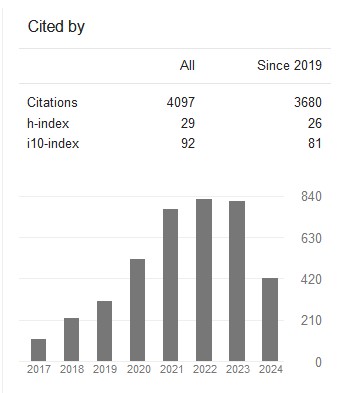
Google Scholar Analysis
For Authors








ijaems Issue
A Physico-Chemical Evaluation of Agricultural Soil Across Villages in Narwana, Jind District, Haryana, India.( Vol-9,Issue-5,May - June 2023 ) |
|
Author(s): Dr. J. P. Deshwal, Shalender Nain |
Download Full Text PDF
Total View : 34
Downloads : 1
Page No: 145-152
|
Keywords: |
|
|
micro nutrients, pH, electrical conductance, soil texture, soil sample, Spectrophotometer, concentration, sustainable agriculture. |
|
Abstract: |
|
|
Since ancient times, India has existed as a deeply rooted agrarian civilization, with its initial societies flourishing near rivers and water sources. Farming serves as the foundation for crucial necessities like sustenance, forage, and protection. However, contemporary practices have overexploited natural elements, triggering an ecological imbalance. Perpetual cultivation without rest leads to a depletion of essential minerals required to feed a massive population. Furthermore, massive applications of synthetic fertilizers, weedkillers, and insect poisons alter the physical composition and inherent traits of the earth. The primary objective of this investigation is to restore soil texture by utilizing organic components such as livestock dung, vegetation remnants, and natural waste. A purely organic mixture named "Divya Amrit" is prepared to generate high-quality natural compost. This formulation aims to boost agricultural yields in both volume and quality while minimizing environmental degradation, moisture requirements, and synthetic chemical inputs. Embracing traditional Indian agricultural techniques offers an ideal pathway for generating adequate volumes of wholesome food and forage for humans and animals alike. To optimize crop production and manage land sustainably, understanding the variation in soil nutrients is essential. This study examines major and minor elements in the farming lands of the Narwana subdivision within Haryana's Jind district, adhering to BIS and ICAR protocols. Quantifying these nutrients was achieved using a UV-visible spectrophotometer, whereas a digital apparatus was employed to record electrical conductivity and PH. The research gauges current fertility levels and promotes organic soil modification. Ultimately, blending classic Indian agricultural tenets— like crafting homegrown manure— provides a straightforward method to decrease reliance on manufactured chemicals, mitigate environmental harm, and protect agricultural viability for the future. |
|
| Article Info: | |
|
Received: 25 Apr 2023; Received in revised form: 19 May 2023; Accepted: 25 May 2023; Available online: 31 May 2023 |
|
Cite This Article: |
|
|
Citations:
APA | ACM | Chicago | Harvard | IEEE | MLA | Vancouver | Bibtex
| |
Share: |
|
 DOI: