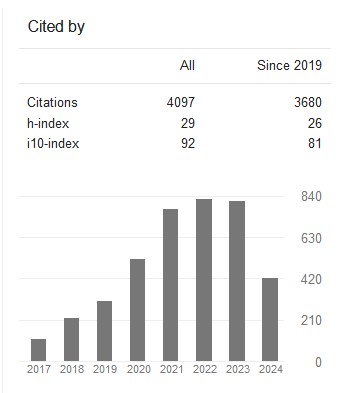
Google Scholar Analysis
For Authors








ijaems Issue
Based on the MATLAB Simulation of Peanut Nest-Hole Wheel-Type Planting Machinery's Seeding Performance( Vol-11,Issue-6,November - December 2025 ) |
|
Author(s): Ben Geng Wu, Hao Wang, Yong Jin Zhong, Ho Sheng Chen |
Download Full Text PDF
Download with Cover Page
Total View : 824
Downloads : 28
Page No: 001-008
|
Keywords: |
|
|
Peanut seeder, Seeding Performance, MATLAB/Simulink, Kinematic Simulation, Nest-Wheel Seed Metering Device |
|
Abstract: |
|
|
Using the nest-wheel seeding device as the research object, a MATLAB-based simulation model for seeding performance was built with the goal of improving the operational efficiency and seeding accuracy of peanut hill-drop planting machinery. This model focused on the motion characteristics of the key components of the seeding device and the rules of interaction between seed groups. In order to simulate and analyze the seed hole occupancy rate, missed seeding rate, and reseeding rate during the seeding process, various operating speeds (20–60 r/min) and hole spacing parameters were set by combining the physical characteristics of peanut seeds (thousand-seed weight, geometric dimensions, and friction coefficient). With the highest seed hole occupancy rate of 93.61% and the lowest missed seeding rate and reseeding rate dropping to 1.74% and 3.79%, respectively, the results demonstrated that the seeding performance was within the ideal range when the nest wheel speed was set at 30 to 40 r/min and the hole spacing was set at 150 mm. This simulation model offers a theoretical foundation for the structural optimization of peanut hill-drop planting equipment and can accurately forecast seeding performance. |
|
| Article Info: | |
|
Received: 29 Sep 2025; Received in revised form: 27 Oct 2025; Accepted: 02 Nov 2025; Available online: 06 Nov 2025 |
|
Cite This Article: |
|
|
Citations:
APA | ACM | Chicago | Harvard | IEEE | MLA | Vancouver | Bibtex
| |
Share: |
|
 DOI:
DOI: