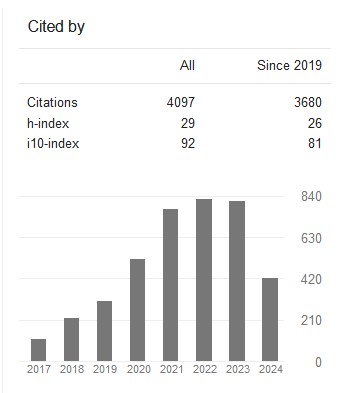
Google Scholar Analysis
For Authors








ijaems Issue
Impact of Information and Communication Technology (ICT) Integration on Teaching Learning Practices in Public Schools of Gilgit Baltistan( Vol-12,Issue-3,May - June 2026 ) |
|
Author(s): Muhammad Adil |
Download Full Text PDF
Total View : 267
Downloads : 13
Page No: 258-263
|
Keywords: |
|
|
ICT integration, teaching-learning practices, Gilgit-Baltistan, digital infrastructure, education policy, student engagement |
|
Abstract: |
|
|
The adoption of new technologies and the use of Information and Communication Technology (ICT) are now recognized as a major contributor to change in the education sector because of its capacity to improve classroom instruction, increase learners' involvement and optimize learners' learning outcomes. Giftedness can, however, be felt differently across different contexts. The effective use of ICT in schools suffers from major challenges in the form of geographical isolation, mountainous topography, unstable electricity, limited internet connectivity and socio-economic constraints in GIBALT. The focus of this research is to examine the level of integration of ICT in public schools of Gilgit-Baltistan especially in Skardu and Ghanche districts. Skardu is relatively more urbanized and well connected, whereas, Ghanche is relatively more constrained due to its isolation and rurality. This research involves both qualitative and quantitative approaches where quantitative data are obtained using survey method and qualitative data using interviews and focus group discussion methods. The research explores the influence of ICT on teaching and learning processes and factors that can either hinder or facilitate this process. The expected outcome will provide guidance for policy makers, school administration, and educational leaders in developing infrastructure, training teachers, and creating an ICT strategy based on leadership. There is currently a gap in literature concerning the role of ICTs in remote and mountainous schools and the use of ICTs in education remains debatable. |
|
| Article Info: | |
|
Received: 01 May 2026; Received in revised form: 29 May 2026; Accepted: 03 Jun 2026; Available online: 05 Jun 2026 |
|
Cite This Article: |
|
|
Citations:
APA | ACM | Chicago | Harvard | IEEE | MLA | Vancouver | Bibtex
| |
Share: |
|
 DOI:
DOI: